Why On Page SEO Still Matters
You have a great website. But nobody is finding it on Google.
Sound familiar? The problem might be your on page SEO.
On page SEO is the process of optimizing individual web pages so they rank higher in search engines. It is one of the most powerful things you can control directly. Unlike backlinks or domain authority, on page SEO is entirely in your hands.
This guide gives you a complete on page SEO checklist you can follow today. Whether you are a beginner or someone brushing up on SEO basics, this checklist will help you take action.
Let’s get started.
What Is an On Page SEO Checklist?
An on page SEO checklist is a structured list of tasks that help you optimize every element on a webpage. It covers everything from your title tag to your image alt text.
Think of it as a quality control system. Before you hit “publish,” you run through the checklist. This ensures your content is ready to rank.
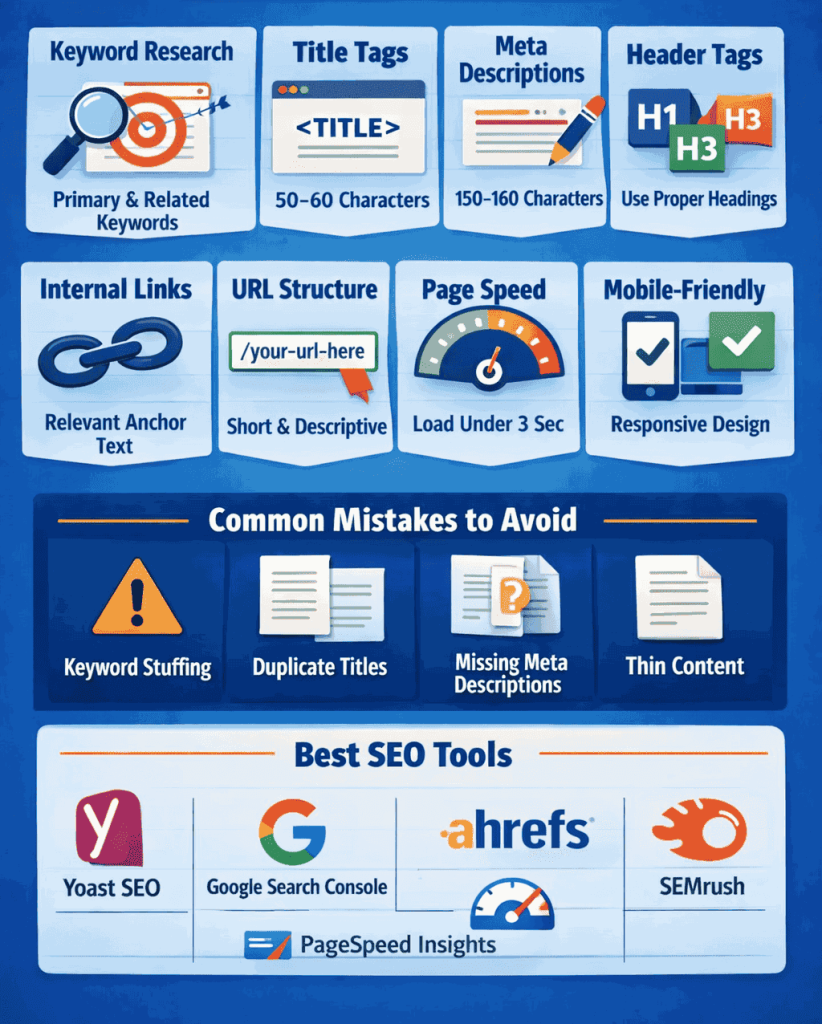
A solid on page SEO checklist typically includes:
- Keyword placement and density
- Title tag and meta description optimization
- Header tag structure (H1, H2, H3)
- Image optimization with alt text
- Internal linking strategy
- URL structure
- Page speed improvements
- Mobile-friendliness checks
Following an on page SEO checklist consistently is one of the best habits you can build as a digital marketer.
Why On Page SEO Is Important
Google reads your pages differently than humans do. It looks at specific signals to understand what your page is about and how helpful it is.
When you follow an on page SEO checklist, you help Google understand your content better. This leads to:
- Higher search rankings for your target keywords
- More organic traffic from relevant searchers
- Better user experience for your visitors
- Lower bounce rate because your content is clear and structured
On page SEO techniques are the foundation of any successful SEO strategy. Even the best backlinks cannot save a page that is poorly optimized.
Complete On Page SEO Checklist: Step-by-Step
Here is your full on page SEO checklist. Go through each section carefully.
1. Keyword Optimization
Keyword optimization is the starting point of any on page SEO checklist. You need to know which keyword you are targeting before you write a single word.
How to do it:
- Choose one primary keyword (e.g., “on page SEO checklist”)
- Find 3–5 related/secondary keywords
- Place your primary keyword in the first 100 words of your content
- Use it naturally throughout the page — avoid keyword stuffing
- Use LSI (Latent Semantic Indexing) keywords to add context
Example: If your primary keyword is “on page SEO checklist,” your related keywords might include on page SEO techniques, how to improve on page SEO, and SEO optimization tips.
Checklist:
- Primary keyword identified
- Keyword appears in first 100 words
- Keyword used naturally 10–20 times in the content
- Related keywords included
2. SEO Title Tag Optimization
Your title tag is one of the most important elements in your on page SEO checklist. It tells both users and search engines what your page is about.
SEO title tag optimization best practices:
- Keep your title between 50–60 characters
- Place your primary keyword near the beginning
- Make it compelling so users want to click
- Avoid duplicate titles across your website
Example:
- ❌ Poor: “SEO Tips”
- ✅ Good: “On Page SEO Checklist: Complete 2026 Guide”
Checklist:
- Title is 50–60 characters
- Primary keyword included near the start
- Title is unique across your site
- Title is click-worthy
3. Meta Description Best Practices
Meta descriptions do not directly impact rankings. But they massively affect click-through rates. A well-written meta description brings more people to your page.
Meta description best practices:
- Keep it between 150–160 characters
- Include your primary keyword naturally
- Write it like a mini ad — make people want to click
- Add a soft call to action (e.g., “Learn more,” “See how”)
Example:
“Follow this on page SEO checklist to rank higher on Google. Learn key on page SEO techniques including title tags, meta descriptions, and image optimization.”
Checklist:
- Meta description is 150–160 characters
- Includes primary keyword
- Has a clear benefit or call to action
- Unique for every page
4. Header Tags (H1, H2, H3)
Header tags structure your content. They also help Google understand the hierarchy of information on your page.
Rules for header tags:
- Use only one H1 tag per page — this is your main title
- Use H2 tags for main sections
- Use H3 tags for subsections under H2s
- Include your primary keyword in the H1
- Sprinkle related keywords in your H2s naturally
Example structure:
H1: On Page SEO Checklist: Complete Step-by-Step Guide
H2: What Is On Page SEO?
H2: Complete On Page SEO Checklist
H3: Keyword Optimization
H3: Title Tag Optimization
Checklist:
- One H1 with primary keyword
- H2s used for major sections
- H3s used for sub-points
- No skipped heading levels
5. Image Optimization (Image Alt Text SEO)
Images make your content engaging. But search engines cannot “see” images — they read the alt text instead. This is where image alt text SEO becomes critical.
Image optimization checklist:
- Compress images before uploading (use tools like TinyPNG)
- Use descriptive, keyword-rich file names (e.g., on-page-seo-checklist.jpg)
- Write clear, descriptive alt text for every image
- Use modern formats like WebP for faster loading
Image alt text SEO example:
- ❌ Poor alt text: image1.jpg
- ✅ Good alt text: on page SEO checklist diagram showing key optimization steps
Checklist:
- All images compressed
- Descriptive file names used
- Alt text added to every image
- Image dimensions optimized
6. Internal Linking
Internal links connect your pages to each other. They pass authority, help users navigate, and help Google discover more of your content.
How to improve on page SEO with internal links:
- Link to relevant pages within your website
- Use descriptive anchor text (not “click here”)
- Aim for 2–5 internal links per post
- Link to your most important pages from new content
Example: In a post about keyword research, you might link to your guide on SEO tools using the anchor text “best SEO tools for beginners.”
Checklist:
- At least 2–3 internal links added
- Descriptive anchor text used
- Links open existing content (not orphan pages)
7. URL Structure
A clean URL is part of a strong on page SEO checklist. Short, descriptive URLs perform better in search and are easier to share.
URL best practices:
- Keep URLs short and descriptive
- Use hyphens (not underscores) between words
- Include your primary keyword in the URL
- Avoid numbers or random characters
Example:
- ❌ Poor: yoursite.com/p=1234
- ✅ Good: yoursite.com/on-page-seo-checklist
Checklist:
- URL includes primary keyword
- URL is short and readable
- Hyphens used between words
- No unnecessary parameters or symbols
8. Page Speed
Page speed is a confirmed Google ranking factor. A slow page frustrates users and hurts your SEO performance.
How to improve page speed:
- Compress and resize images
- Enable browser caching
- Use a content delivery network (CDN)
- Minify CSS, HTML, and JavaScript files
- Choose a fast hosting provider
Target: Aim for a page load time of under 3 seconds.
Use Google PageSpeed Insights to test your site and get specific recommendations.
Checklist:
- Page loads in under 3 seconds
- Images are compressed
- Caching is enabled
- CDN is in use (if applicable)
9. Mobile-Friendliness
More than 60% of web traffic comes from mobile devices. Google uses mobile-first indexing. If your site is not mobile-friendly, your rankings will suffer.
Mobile SEO checklist:
- Use a responsive design that adapts to all screen sizes
- Ensure buttons and links are easy to tap
- Avoid intrusive popups on mobile
- Test your site using Google’s Mobile-Friendly Test tool
Checklist:
- Site passes Google’s Mobile-Friendly Test
- Fonts are readable on small screens
- No horizontal scrolling required
- Tap targets are large enough
Common On Page SEO Mistakes to Avoid
Even experienced marketers slip up. Here are the most common mistakes to watch for when using your on page SEO checklist:
- Keyword stuffing — Overusing your keyword makes content unreadable and can trigger Google penalties
- Missing meta descriptions — Leaving them blank means Google writes them for you (often badly)
- Duplicate title tags — Every page needs a unique title
- Ignoring image alt text — This leaves accessibility and ranking opportunities on the table
- Thin content — Pages with fewer than 300 words often struggle to rank
- Broken internal links — These hurt user experience and waste crawl budget
Avoiding these mistakes is just as important as following your on page SEO checklist properly.
Best On Page SEO Tools
You do not have to do everything manually. These tools make your on page SEO checklist faster and easier to implement:
| Tool | Best For |
| Yoast SEO (WordPress) | Real-time on page analysis |
| Surfer SEO | Content optimization and keyword density |
| Google Search Console | Performance tracking and indexing |
| Ahrefs / SEMrush | Keyword research and competitor analysis |
| PageSpeed Insights | Page speed and Core Web Vitals |
| Screaming Frog | Full site SEO audit and crawl analysis |
These tools help you action your on page SEO checklist more efficiently, especially when managing multiple pages.
FAQ: On Page SEO Checklist
Q1. What is the most important element of an on page SEO checklist?
The title tag is widely considered the most important element. It directly tells Google and users what your page is about. Including your primary keyword near the beginning of the title is a key on page SEO technique that can significantly improve your rankings.
Q2. How often should I update my on page SEO checklist?
You should review your on page SEO checklist at least once a year — or whenever Google makes major algorithm updates. SEO best practices evolve. What worked in 2022 may not be optimal in 2026. Regular audits using tools like Screaming Frog or Ahrefs keep your optimization current.
Q3. How many times should I use my keyword on a page?
There is no strict rule, but a good benchmark is to use your primary keyword once every 100–150 words. For a 1,500-word article, that is roughly 10–15 times. Focus on reading naturally first — if the keyword fits, use it. This is core to how to improve on page SEO without over-optimizing.
Q4. Does meta description affect Google rankings?
Meta descriptions do not directly affect rankings. However, they influence click-through rates (CTR). A compelling meta description brings more visitors to your page. More clicks can indirectly signal relevance to Google, which can help your ranking over time. Following meta description best practices is always worthwhile.
Q5. What is the difference between on page SEO and off page SEO?
On page SEO refers to all optimizations you make directly on your website — titles, content, images, URLs, page speed, etc. Off page SEO refers to external factors like backlinks, social signals, and brand mentions. Both matter, but your on page SEO checklist should always come first — there’s no point building backlinks to a poorly optimized page.
Conclusion: Start Using Your On Page SEO Checklist Today
Getting your on page SEO right is one of the smartest investments you can make in your website.
This on page SEO checklist covers every key element — from SEO title tag optimization to meta description best practices, from image alt text SEO to mobile-friendliness. Each step builds on the last.
The good news? You do not need to perfect everything at once. Start with your title tags and meta descriptions. Then move to content and images. Bit by bit, you will turn your pages into well-optimized, rankable assets.
Bookmark this on page SEO checklist and come back to it every time you publish new content. Consistency is what separates sites that rank from those that don’t.
Ready to go deeper? Check out our related guides: Complete SEO guides